
AIDR
See How It Works
Technical capabilities that set Vigil Guard apart
Vigil Guard Enterprise: Technical Overview
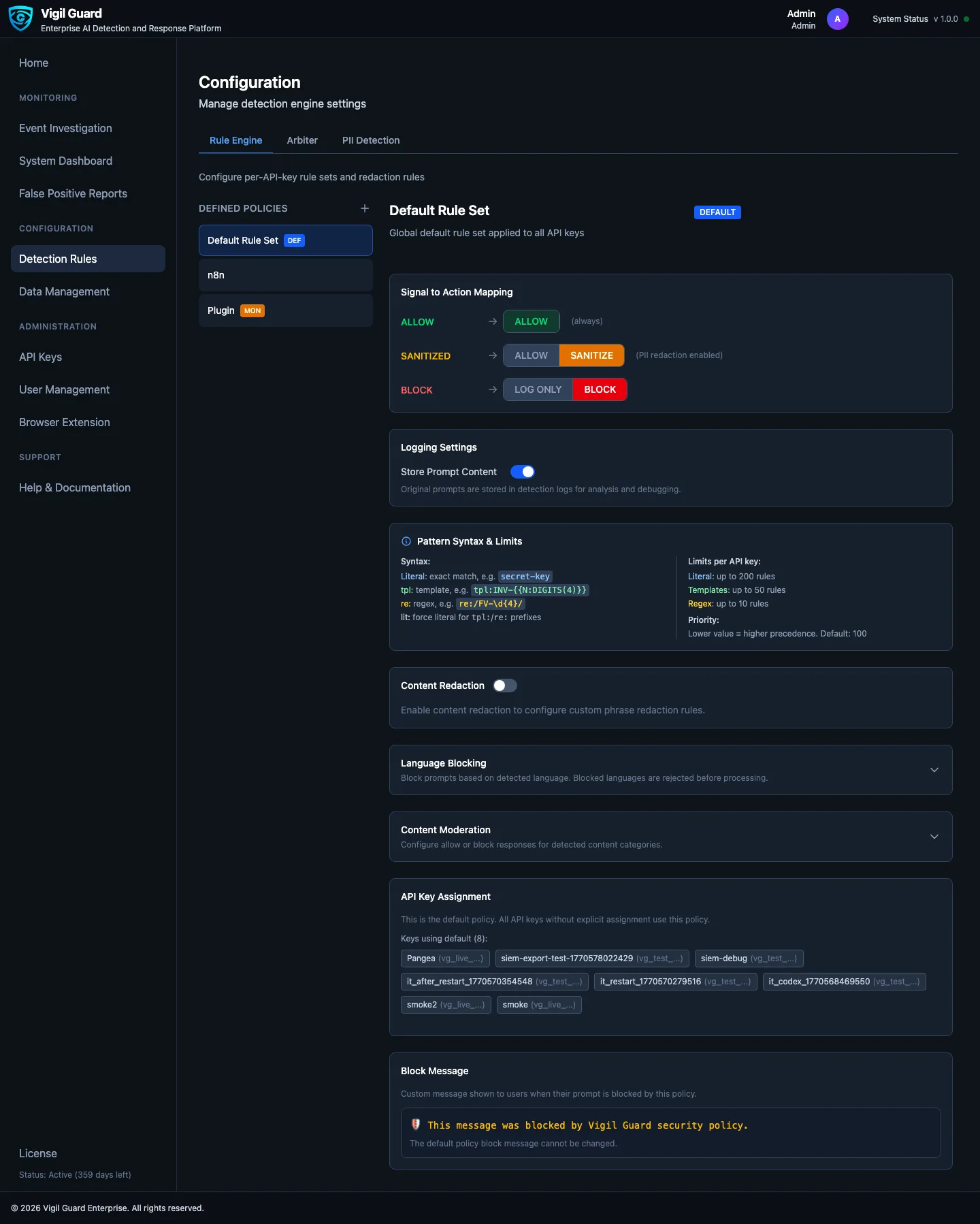
The first AI Detection & Response platform built around prompt injection detection (direct and indirect) across six parallel branches, under 300 ms P99. For the first time, security teams see the full attack surface around an LLM: what goes in, what comes out, where the assistant leaves its defined role. A weighted arbiter returns ALLOW, SANITIZE, or BLOCK. Docker Compose, on-premise, air-gapped, no cloud, no GPU, natively bilingual Polish and English. Download the datasheet for the complete detection architecture specification.
- Six detection branches in a single REST call, under 300 ms P99: language detection, heuristic analysis, semantic analysis, ML classifier for direct and indirect prompt injection, content moderation across 9 safety categories, Semantic Drift Detection. Weighted arbiter resolves to ALLOW, SANITIZE, or BLOCK.
- Semantic Drift Detection: ON / NEAR / OFF_SCOPE classification per API key, AES-encrypted Scope Definition audited by SHA-256 fingerprint, three sensitivity levels. First AIDR module that keeps an assistant inside its declared role.
- 20+ PII entity types redacted before data reaches the model: PESEL, NIP, REGON, Luhn-validated credit cards, IBAN, email, phone numbers. Replace, hash, or mask, configurable per API key.
- One rule engine and one CEF / JSON event export to Splunk, QRadar, Sentinel, Elastic SIEM across five deployment patterns: Chrome extension (Shadow AI, GPO / Intune / Jamf), n8n, central LiteLLM proxy, Python SDK + REST, batch up to 100 prompts.
- Docker Compose on one Linux x86_64 host. Zero external calls, zero telemetry, zero GPU. Fully air-gapped. Auto-scaling picks a profile from host CPU, RAM, and disk. FP/FN memory system learns from your team's feedback.
Security Architecture of Vigil Guard
Explore the technical capabilities powering AI detection and response.
Multi-Layer Threat Detection
Real-time detection of AI-specific threats with configurable sensitivity for each detection layer. Multiple detection engines work in parallel to catch threats that single-layer solutions miss.
- Prompt injection attacks and jailbreak attempts
- Data exfiltration and information leakage
- Malicious instruction patterns and encoded payloads
- Social engineering in AI conversations
- Indirect prompt injection via external content
- System prompt extraction attempts
- Role-playing and persona manipulation attacks
- Token smuggling and Unicode exploits
- Self-learning from feedback to eliminate false positives and negatives
- Configurable detection thresholds
- Real-time threat scoring with confidence levels
Vigil Guard learns from administrator feedback to continuously reduce false positives and false negatives. The system adapts to your specific AI agent environment over time.
Why existing security tools are not enough
EDR
Protects endpoints.
Blind to prompts, outputs and AI decisions.
DLP
Protects data at rest.
Does not see generated content.
WAF
Understands HTTP traffic.
Has no understanding of LLM intent.
AI operates at runtime. Security must operate at runtime too.
You can't secure what you don't see.
AI is already part of your environment. Vigil Guard makes it visible, controllable and safe.